

Generative AI has moved from a novelty to a core part of how modern businesses build products, automate work, and create content. Behind every generative AI application — a chatbot, a coding assistant, an image generator, a document summarizer — sits a stack of tools that make it possible to build, train, fine-tune, and deploy models efficiently. Three names come up again and again in that stack: Ollama, Hugging Face, and NVIDIA.
This guide walks through what each of these platforms actually does, the best free models available right now, and how a Generative AI development partner like webmerito helps businesses turn an idea into a working product.
What Is Generative AI, in Practical Terms?
Generative AI refers to models that create new content — text, code, images, audio, or video — rather than simply classifying or predicting a fixed label. Large language models generate text and code; diffusion models generate images; and multimodal models increasingly do several of these at once. What has changed dramatically over the last two years is accessibility: open-weight models now compete closely with proprietary ones on many tasks, and free tools make it possible for a small team to build, test, and ship AI features without a research lab's budget.
Top Generative AI Tools You Should Know

1. Ollama — Run Models Locally, for Free
It's one of the easiest ways to download and run open-weight models on your own laptop or server, entirely offline. Instead of calling a paid API, you pull a model with a single command and run it locally with full data privacy and zero per-token cost. It has become the default starting point for developers who want to prototype with LLMs, test coding assistants, or build private, self-hosted tools without sending data to a third party.
It supports several hundred models directly from its own library, and thousands more can be imported from other open repositories. It works well alongside frameworks like vLLM (for production-scale serving) and LM Studio (for a desktop GUI), making it flexible for everything from a solo developer's laptop to an internal company tool.
2. Hugging Face — The Hub for Open-Source Models
It's the largest open repository of models, datasets, and demo apps ("Spaces") on the internet, hosting well over a hundred thousand models across text, image, audio, and video generation. It's often called the "GitHub of AI" because of how central it has become to open-source model development, hosting, and sharing.
Beyond hosting, it provides the Transformers library — the standard toolkit for loading and running most open models in Python — Inference Endpoints for hosted deployment, and browser-based Spaces where you can test a model before committing to any setup. For teams building AI features, this is usually where model selection and experimentation happens first.
3. NVIDIA — Enterprise-Grade Infrastructure
While local-inference tools and open-model hubs are strongest for experimentation and self-hosting, this vendor focuses on the infrastructure layer that enterprises need to deploy models reliably at scale. Its key tools include:
- NIM: Prebuilt, optimized inference microservices that let you deploy a foundation model on accelerated infrastructure — cloud, data center, or workstation — with production-grade throughput and latency out of the box.
- NeMo: An open, agent-first suite of libraries covering the full agent lifecycle: data curation, model customization, fine-tuning, evaluation, guardrailing, and retrieval-augmented generation via NeMo Retriever.
- Nemotron: A family of open models (Nano, Super, and Ultra sizes), built specifically for efficient, accurate agentic applications, reasoning, and multi-agent systems at scale.
In short: local tooling and open-model hubs help you experiment and choose a model; this enterprise infrastructure stack helps you run that model reliably, securely, and cost-effectively once you are ready for production.
Top Free Models Worth Knowing

The open-source model landscape moves fast, but a handful of free, permissively licensed models consistently stand out across categories.
Best for text and reasoning:
- Qwen2.5-72B / Qwen2.5-Coder: A strong, well-rounded option that performs impressively on coding and reasoning benchmarks.
- DeepSeek R1 / DeepSeek V3: Particularly strong for math and step-by-step reasoning, with a distilled family that scales down to consumer hardware.
- Llama 3.3 (Meta): Notable for long context windows and solid multilingual support, useful for document-heavy and RAG applications.
- Kimi K2.6 / K3: Among the strongest open-weight options for agentic coding, tool use, and long multi-step tasks.
- Gemma 2 (Google): A lightweight, efficient option that runs comfortably on a single consumer GPU.
- GPT-OSS: A smaller footprint suitable for local deployment.
Best for coding:
- Qwen2.5-Coder and Codestral (Mistral): Built for multi-file code editing and agentic coding workflows.
- StarCoder2: Notable for fully transparent, auditable training data, which matters for enterprises concerned about IP compliance.
Best for image generation:
- FLUX.1 (Black Forest Labs): Ranges from a fully commercial Apache 2.0 model (Schnell) to higher-quality non-commercial and instruction-editing variants (Dev).
- Stable Diffusion 3.5: The long-standing backbone of the open image-generation community.
Best for speech and audio:
- Whisper (OpenAI): The standard free option for speech-to-text transcription.
- Parakeet / Canary: Strong open speech recognition and translation models available through NeMo and NIM.
All of these can be run locally with the right tooling, downloaded from an open-model hub, or deployed at production scale through enterprise-grade infrastructure — meaning a team building an AI product genuinely does not need to start with a large licensing budget.
Why Businesses Are Investing in This Technology
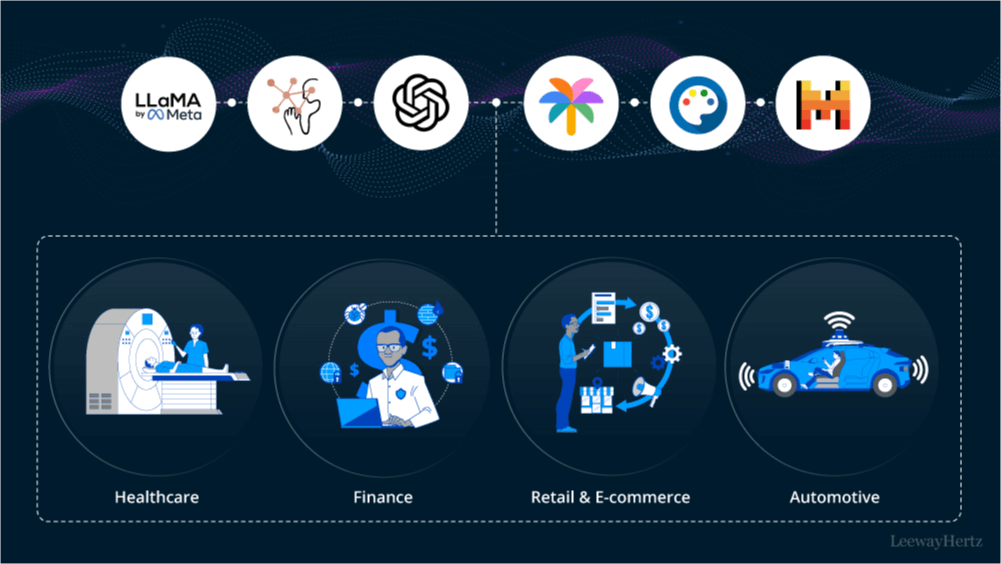
- Faster content and code production: From marketing copy to boilerplate code, these tools compress hours of work into minutes.
- Smarter customer interactions: AI-powered chat and support tools handle nuanced, natural-language queries far better than older rule-based bots.
- Data-driven decision-making: Models can summarize, analyze, and surface insights from large volumes of unstructured data almost instantly.
- Cost control through open models: Self-hosting an open-weight model converts unpredictable per-token API costs into a fixed infrastructure cost, which matters for high-volume applications.
- Data privacy: Running models locally or on your own cloud keeps sensitive data from leaving your infrastructure, an increasingly important requirement in regulated industries.
Common Challenges
Every Generative AI development effort runs into the same handful of obstacles, regardless of industry:
- Choosing the right model: With hundreds of free models available, picking the one that fits your task, hardware, and licensing needs requires real expertise.
- Infrastructure and hosting: Self-hosting means managing GPUs, memory, and scaling, a very different skill set from typical web development.
- Fine-tuning and customization: Getting a general-purpose model to perform well on your specific business data usually requires fine-tuning, RAG pipelines, or prompt engineering.
- Integration: Connecting a model into your existing product, CRM, or internal tools is often more work than the AI part itself.
- Evaluation and safety: Testing for hallucinations, bias, and unsafe outputs before shipping a feature to real users.
How webmerito Helps
Here is how webmerito supports businesses across the AI development journey:
- Model selection and strategy: Evaluating whether an open-source model (via local tooling or an open-model hub), a hosted API, or an enterprise-grade deployment is the right fit for your use case, budget, and data-privacy requirements.
- Custom application development: Building chatbots, content generation tools, document intelligence systems, image and design tools, and coding assistants tailored to your business.
- LLM and ChatGPT integration: Embedding large language models into your existing websites, apps, and internal systems with proper prompt design and safety guardrails.
- Fine-tuning and RAG pipelines: Customizing open models on your own data and building retrieval-augmented generation systems so responses are grounded in your actual business content, not just general knowledge.
- Infrastructure and deployment: Setting up scalable, secure hosting on AWS, Azure, or GPU-accelerated infrastructure, with proper monitoring, cost control, and DevOps practices.
- End-to-end product engineering: Because webmerito also builds web apps, mobile apps, and cloud systems, your feature ships as part of a polished, production-grade product, not a disconnected prototype.
- Ongoing optimization: Monitoring model performance, cost, and output quality after launch, and iterating as your data and use cases evolve.
Industries Where webmerito Delivers
webmerito applies the same core toolset — LLMs, RAG pipelines, fine-tuning, and model deployment — to address the specific business challenges faced by each sector:
- E-Commerce: AI-generated product descriptions, personalized recommendation engines, visual search, and support chatbots that handle order queries and returns.
- Healthcare: Document summarization for clinical notes, HIPAA-aware assistants, appointment and intake automation, and RAG systems grounded in verified medical content.
- Finance & Banking: Automated report generation, fraud pattern analysis, document and KYC processing, and internal knowledge assistants for compliance teams.
- Education: Tutoring assistants, automated content and quiz generation, personalized learning recommendations, and smart grading support.
- Real Estate: AI-generated property listings, virtual assistants for buyer queries, and document summarization for legal and contract paperwork.
- Travel & Hospitality: Conversational booking assistants, personalized itinerary generation, and multilingual support for global customers.
- Logistics & Supply Chain: Automated documentation, natural-language data queries over shipment and inventory systems, and predictive insights from operational data.
- Legal & Law: Contract summarization and review assistants, legal research support, and RAG-based systems for searching large document repositories.
- Manufacturing: Technical documentation assistance, predictive maintenance insights, and internal knowledge assistants for engineering teams.
- Technology & SaaS Startups: Embedding LLM-powered features directly into products, from in-app copilots to AI-driven analytics and automation layers.
Final Thoughts
This technology is no longer limited to companies with massive research budgets. Between easy local experimentation, a vast open-model ecosystem, and enterprise-grade deployment infrastructure, Generative AI development has never been more accessible — businesses of nearly any size can now build real, production-ready systems using largely free, open-source AI models.
The hardest part is no longer finding a model — it is choosing the right one, integrating it properly, and deploying it reliably. That is where webmerito's Generative AI development team comes in, bringing full-stack engineering expertise to make sure your project becomes a working product, not just a proof of concept.
Frequently Asked Questions
1. What is the difference between Ollama, Hugging Face, and NVIDIA NIM?
Ollama is a lightweight tool for running open models locally on your own machine, Hugging Face is a hub for discovering and experimenting with open-source models and datasets, and NVIDIA NIM is an enterprise deployment layer for running models at production scale with optimized performance on accelerated infrastructure. Many teams use all three at different stages of the same project: find a model, prototype with it locally, then deploy it in production.
2. Are free models good enough for real business use?
Yes, in most cases. Leading open-weight models like Qwen, DeepSeek, Llama, and Kimi now perform close to proprietary models on many practical tasks, especially coding, summarization, and general reasoning. The gap remains largest on the most demanding reasoning and multimodal tasks, but for the majority of business applications, free models are a genuinely viable starting point.
3. Do I need a powerful GPU to use these tools?
Not necessarily. Many free models are available in smaller, quantized sizes that run comfortably on a single consumer GPU or even a laptop. Larger, frontier-scale open models do require serious hardware or cloud infrastructure, which is exactly where a partner like webmerito can help you choose the right scale for your budget.
4. What's the difference between using a hosted API and self-hosting an open model?
A hosted API is simpler to start with but charges per token and sends your data to a third party. Self-hosting an open model requires more setup but gives you fixed infrastructure costs and full control over data privacy — an important factor for regulated industries.
5. Can webmerito build a custom application for my business?
Yes. webmerito designs and builds custom applications end to end — from model selection and fine-tuning to full product development and deployment — tailored to your specific business processes and data.
6. How long does a typical project take?
A focused pilot, such as a document-summarization tool or a customer support chatbot, can often be built and tested within a few weeks. Larger, custom-trained systems integrated with multiple internal tools typically take longer and are best delivered in phases.
7. Is my data safe if I use open-source AI models?
Open-source AI models themselves do not inherently expose your data — the key factor is where the model runs. Self-hosting keeps all processing within your own infrastructure, which is generally more private than sending data to a third-party API.
8. How do I get started?
Start by identifying one clear, high-value use case — such as automating a repetitive content task, building an internal knowledge assistant, or adding a chatbot to your product. From there, a technology partner like webmerito can help you pick the right model, architecture, and hosting approach, and build a working pilot to prove value before scaling further.
Ready to build a high-performance Generative AI application?
Talk to the team at webmerito and get a free discovery session today.
Schedule Discovery Call