

Google has officially released Gemini 3.0, marking what may be the most significant advancement in generative AI since launching the original Gemini. It was released on November 18, 2025, this new model family represents a fundamental shift in how AI systems interact with users and how it can execute complex tasks. Unlike previous versions that focused on small improvements, Gemini 3.0 introduces capabilities that transform AI from a tool you consult into an intelligent agent embedded directly into your workflow.
The implications are great. Gemini 3 has already topped the LM Arena leaderboard with a 1501 Elo score, which is the highest rating ever recorded. It reached 2 billion users instantly through Google Search integration, 650 million through the Gemini app, and immediate availability across Google Cloud services. This day-one distribution scale demonstrates Google's unmatched ability to deploy cutting-edge AI to the world's largest audience.
From Chatbot to Autonomous Agent: The Paradigm Shift
The fundamental breakthrough in Gemini 3.0 does not lie in answering a question faster, but in executing complex workflows autonomously. Previous AI models operated on reaction, you asked a question, they provided an answer. Gemini 3.0 operates on intelligence and information, understanding your intent and executing multi-step processes without the need for constant guidance.
Consider a practical example. Tell the previous generation of AI to "organize my inbox," and it would provide steps or suggestions. Tell Gemini 3.0 the same thing, and it actually does it. The model scans your email content, categorizes messages by importance, flags items requiring responses, drafts reply suggestions, groups similar emails, and presents organized results and all of this is done simultaneously.
This capability extends to more complex scenarios. You can now tell Gemini 3.0: "Research and help me book a mid-size SUV for my trip next week under $80 per day using details from my email." The model locates your flight information from Gmail, compares rental options within your budget, prepares booking details, and waits for your confirmation before completing the transaction. You are the one who remains in control all the time. While Gemini seeks approval for critical actions, its work gets done through intelligent reasoning rather than manual steps. This represents what Google calls the shift toward "agentic AI" — systems capable of planning, tool use, and execution within well-defined boundaries.
Technical Breakthroughs: Reasoning, Multimodal Understanding, and Context
Gemini 3.0 achieves its capabilities through several core technical advances. The model expands context window support beyond the 2 million tokens available in Gemini 2.5 Pro, allowing it to maintain coherence over extended conversations and complex document analysis. The model's reasoning capabilities have dramatically improved through what Google calls "Deep Think".
Deep Think is a mode where the model internally decomposes problems into sub-problems, evaluates multiple solution paths, and self-corrects before producing output. Multimodal capabilities have also reached new heights. Gemini 3.0 Pro scores 81% on MMMU-Pro and 87.6% on Video-MMMU, demonstrating world-leading understanding of images, video, audio, and text simultaneously.
Generative UI: AI That Creates Experiences, Not Just Text
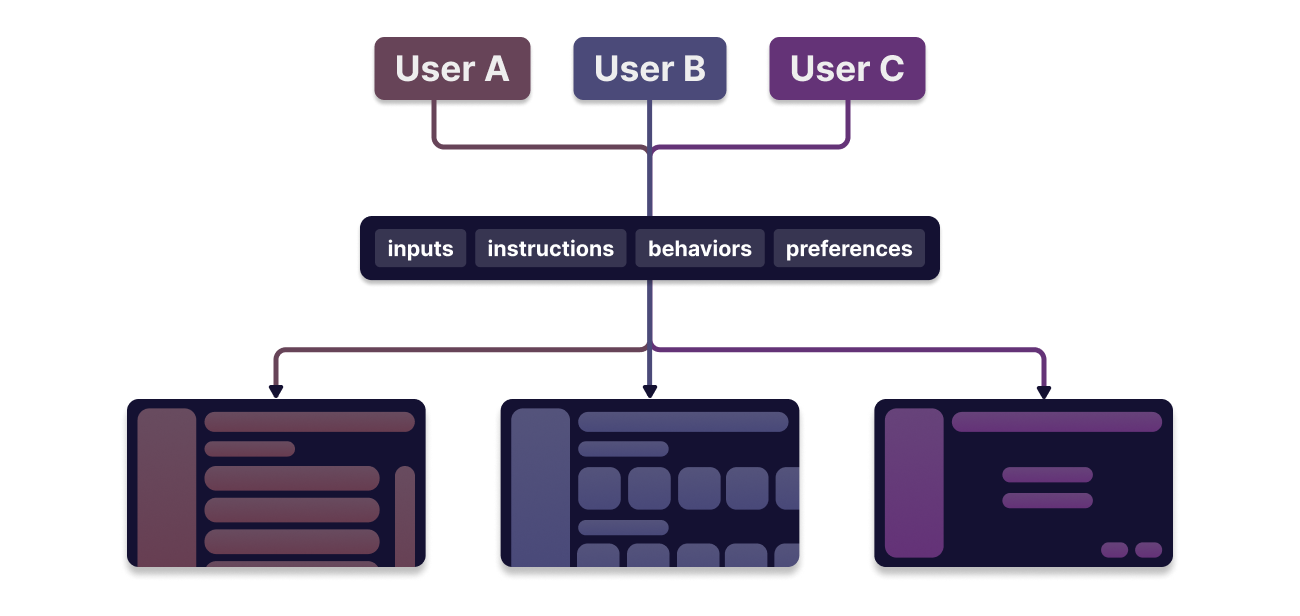
One of Gemini 3.0's most striking features is its ability to generate dynamic, interactive user interfaces rather than the same old text responses. Google calls this "Generative UI," and it fundamentally changes how users interact with AI.
When you ask a traditional AI about Vincent van Gogh, it returns text paragraphs. Gemini 3.0 constructs an interactive experience. For example, a timeline visualization, high-resolution image galleries, contextual artwork analysis, and navigation elements that feel like a designed product, not a text response. For financial calculations, rather than explaining formulas or linking to external calculators, Gemini 3.0 generates a fully functional calculator with interactive sliders, input fields, and real-time calculations embedded directly in the conversation.
This capability transforms how users access information. Responses aren't always the same information blocks; they're experiences tailored to the specific context of your query. A teacher might ask for lesson plans, and receive an interactive curriculum builder. A student might ask about the solar system, and receive an interactive visualization with orbital mechanics they can manipulate in real-time.
Agentic Coding: The Developer's Dream Model
For software developers, Gemini 3.0 represents a massive leap in capability. The model tops the WebDev Arena leaderboard with an impressive 1487 Elo rating, demonstrating superior frontend development capabilities. It achieves 76.2% on SWE-bench Verified and 54.2% on Terminal-Bench 2.0.
What makes this significant is that Gemini 3.0 doesn't just write code, Gemini 3.0 executes it. Developers using Gemini 3.0 through Cursor, GitHub Copilot, JetBrains, or Google's new Antigravity platform can ask the model to build features, fix bugs, or optimize code, and the model actually runs the commands, sees the errors, debugs issues, and completes multi-step workflows autonomously.
Google introduced "vibe coding" terminology to describe this capability. It is the ability to translate high-level natural language descriptions into fully functional, interactive applications with minimal prompting. You can describe a game concept and Gemini 3.0 builds a working prototype.
Google Antigravity: The Revolutionary Agentic IDE
Google also launched Antigravity, a groundbreaking agentic development platform that reimagines how developers write code. Unlike traditional IDEs where developers type commands, Antigravity gives AI agents direct access to the editor, terminal, and browser, enabling fully autonomous software development.
The system uses Gemini 3 Pro as its foundation. Describe what you want to build in natural language, for example, "Create a dashboard that tracks real-time analytics with interactive charts." Antigravity's AI agent breaks this down into implementation steps, writes the code, runs it in the terminal, tests the output in the browser, identifies errors, fixes them, and iterates until the feature works perfectly. All without you touching the keyboard.
For startup founders, Antigravity means building MVPs in hours instead of weeks. For enterprise teams, it means accelerating development cycles and reducing technical debt. The platform represents the maturation of AI-assisted development from "help me write this function" to "build this entire feature end-to-end."
Availability and Pricing: Democratizing Advanced AI
Gemini 3 Pro is available now across multiple platforms. The model launched simultaneously in Google Search AI Mode, the Gemini app, Google AI Studio, Vertex AI, and third-party platforms like Cursor, GitHub, and JetBrains. Pricing is competitive, costing $2 per million input tokens and $12 per million output tokens for prompts of 200k tokens or less.
Looking Ahead: The Future of AI-Assisted Work
Gemini 3.0 represents more than a technical achievement, it signals the beginning of a new era where AI agents handle increasing complexity with less human intervention. The next logical step is systems that don't just execute tasks within Google's ecosystem but bridge across disconnected services, managing complex workflows that span multiple applications and services.
The release of Gemini 3.0 doesn't represent incremental progress, it's a step function change in what's possible with generative AI. Google has moved from building tools that assist humans to building systems that can autonomously execute complex workflows while keeping humans in control. The AI revolution isn't coming, it's here, and it's called Gemini 3.0.