

Ask most hotel owners why they need a hotel website and you'll hear familiar answers. "To look professional." "To take direct bookings." "To avoid OTA commissions." All valid. All incomplete.
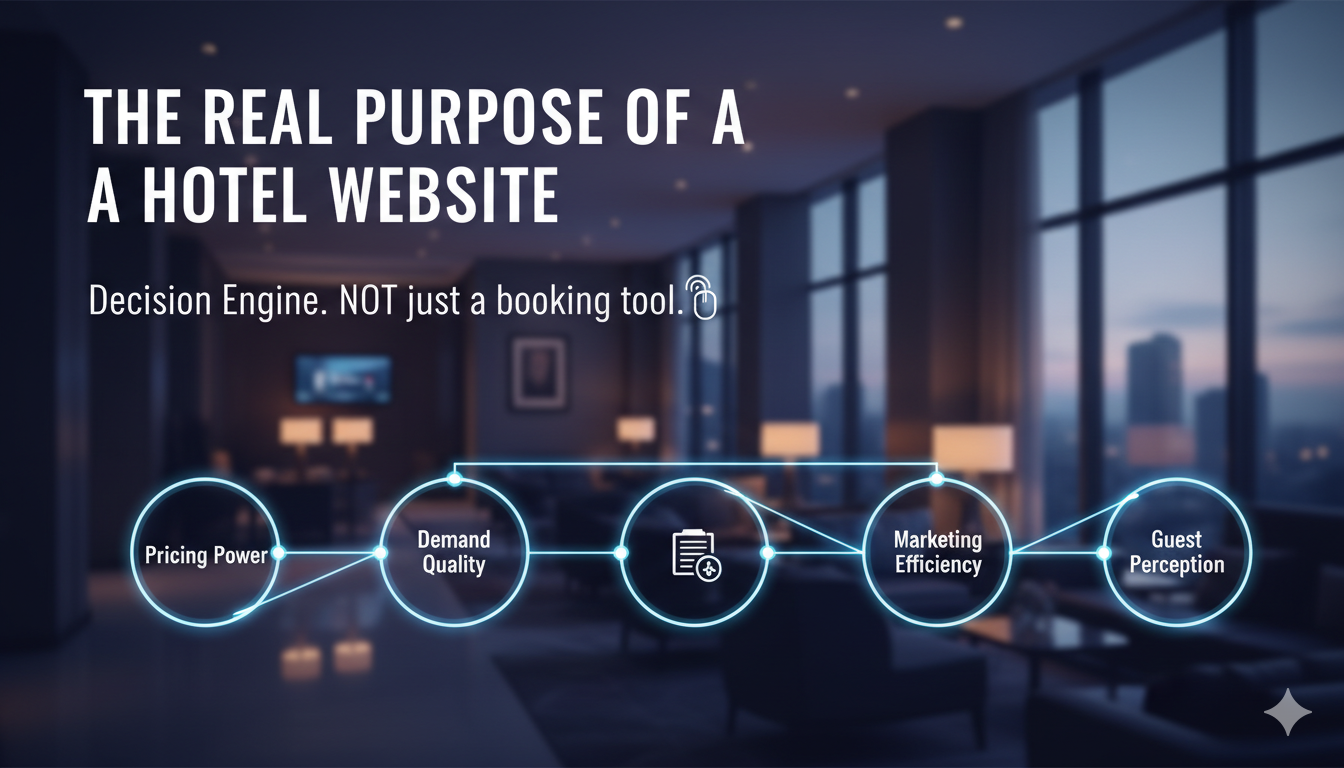
Because the real purpose of a hotel website is something far more strategic and strangely, rarely discussed. A hotel website isn't just a booking tool. It's a decision engine. Every serious revenue outcome from pricing power, demand quality, marketing efficiency, even guest perception, all quietly begins here.
Your Hotel Website Is Where Revenue Decisions Start
Before a guest compares prices on OTAs, before they check reviews, before they decide whether your hotel feels "worth it" they land on your hotel website.
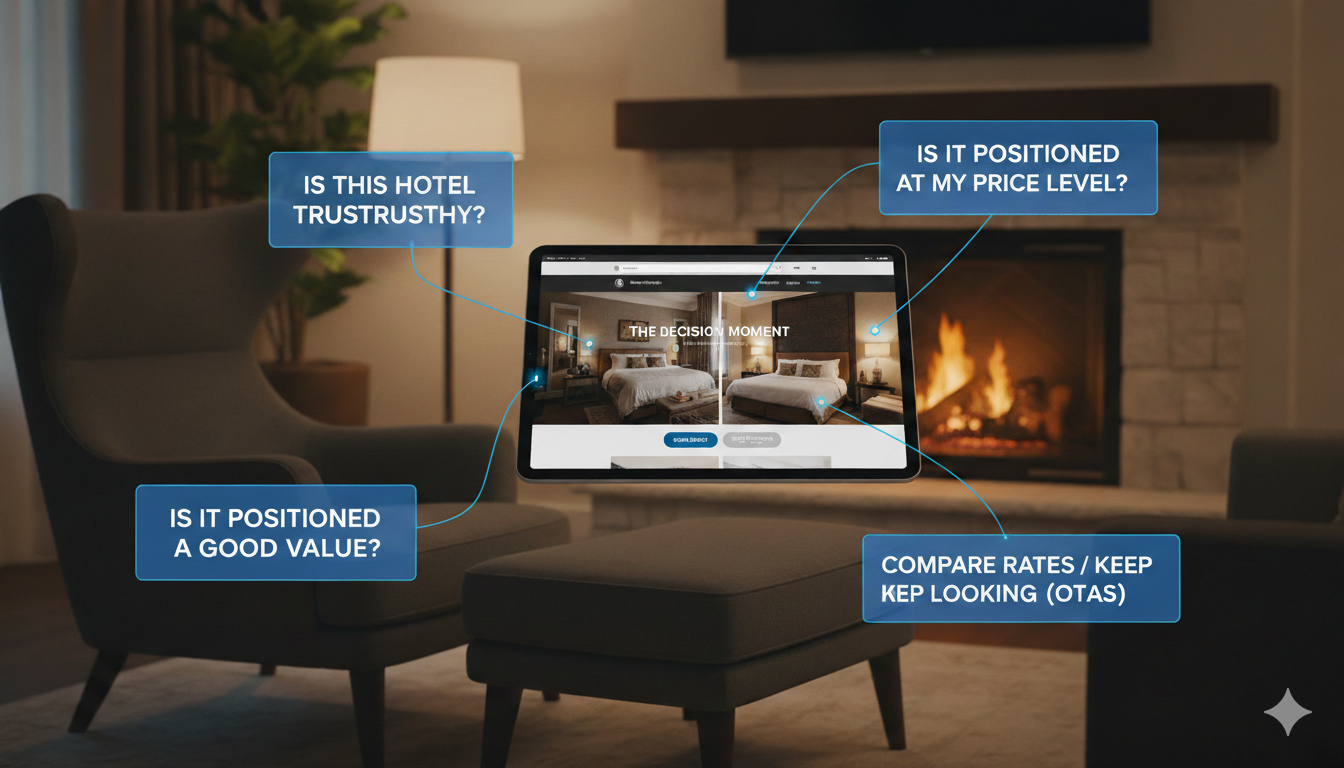
Think about the last time you searched for a hotel. You probably started somewhere. Maybe Google. Maybe a recommendation. But at some point, you arrived at that property's hotel website. And in those few seconds, you subconsciously decided:
- Is this hotel trustworthy?
- Is it positioned at my price level?
- Does it feel better, equal, or worse than alternatives?
- Should I book now or keep looking?
That moment shapes conversion behaviour everywhere else and that includes OTAs. This is the critical part that most hotel owners miss. Your Hotel website isn't competing just with other direct bookings. It's shaping how guests perceive your property across every channel they encounter it on.
A weak website doesn't just lose direct bookings. It lowers your perceived value, which impacts how guests respond to pricing across all channels. When someone visits your websites and leaves without booking, they don't disappear. They go to OTAs. And now they're pre-disposed to think your property isn't worth the asking price, because your digital presentation didn't convince them otherwise.
The Silent Role Websites Play in Pricing Power
Here's the uncomfortable truth: You cannot sustainably push higher rates if your hotel website doesn't justify them. Most hoteliers approach pricing analytically. They look at demand curves, seasonal patterns, competitor rates, and market conditions. All important. But they're missing half the equation.
Guests don't think in numbers they think in signals:
- Layout quality. Does navigating the site feel effortless or frustrating?
- Content clarity. Can a guest instantly understand what makes your property different?
- Image credibility. Do your photos look authentic, professionally shot, and consistently styled?
- Ease of navigation. Can someone find room information, amenities, and booking options without confusion?
- Booking confidence. Do the final steps before purchase feel secure and straightforward?
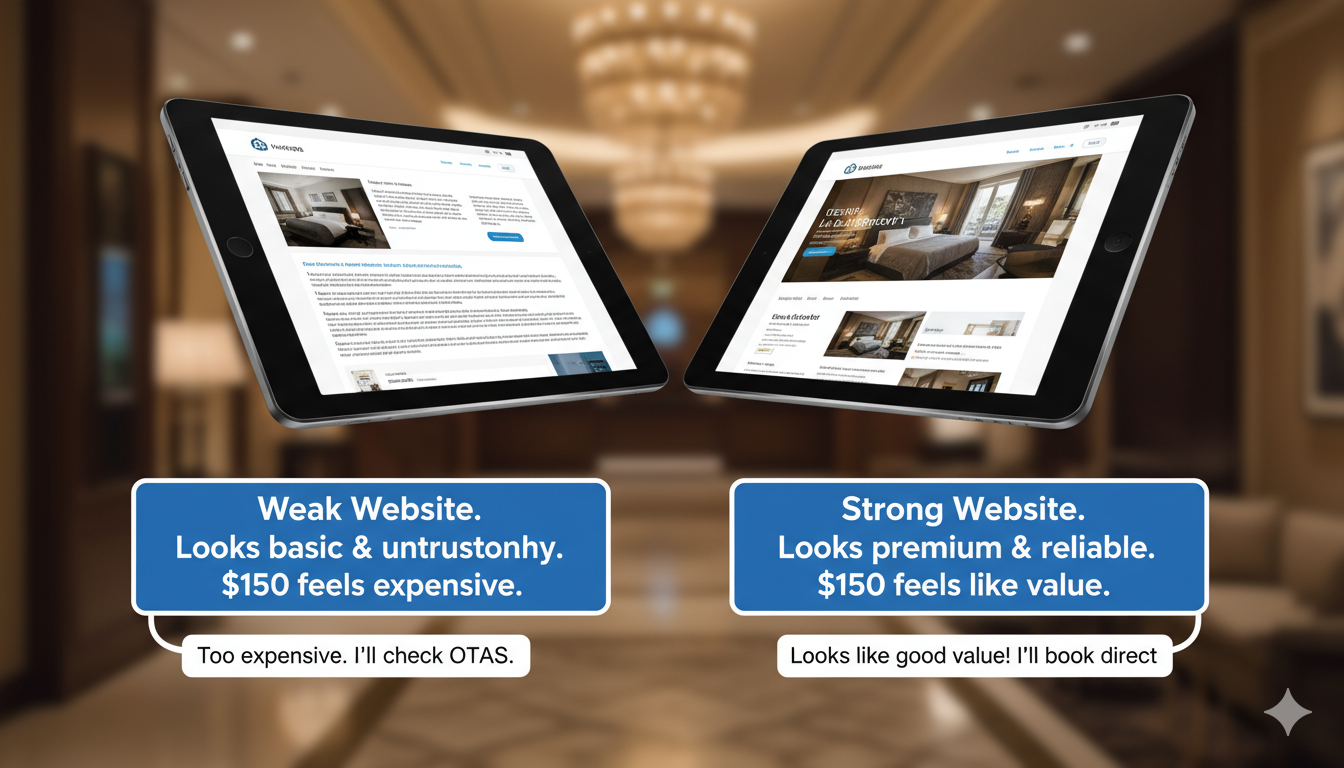
When these signals are weak, even a perfectly calculated rate feels "expensive". Guests second-guess. They bounce. They shop more aggressively on OTAs. When these signals are strong, the same rate feels reasonable and sometimes even cheap. Guests move faster through the booking journey. They trust the property enough to book directly.
This is why hotels often blame demand, seasonality, or competition for lower conversion and revenue. The real issue is that their website isn't supporting their revenue strategy. A $150 rate on a mediocre website feels overpriced. The same $150 rate on a well-designed, strategically built website feels like value.
Marketing Performance Depends on Website Intelligence
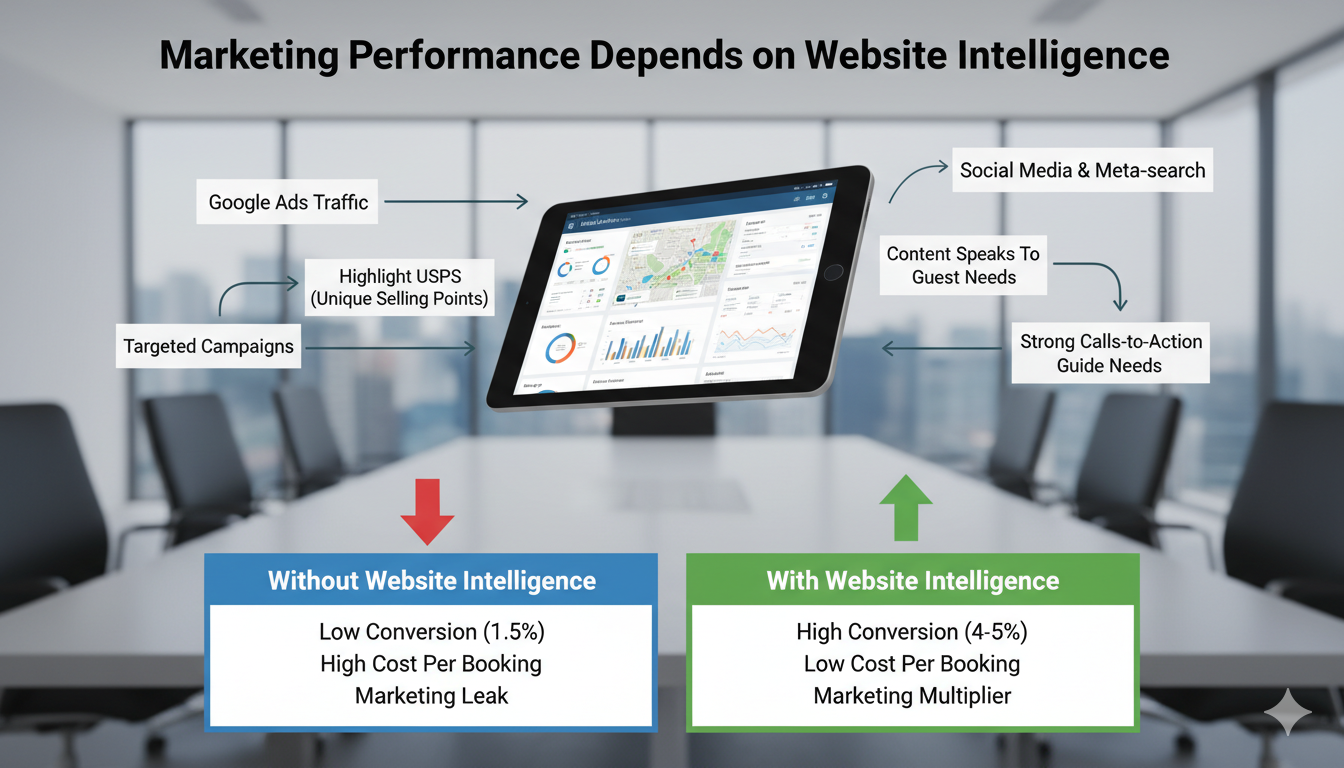
Hotels spend heavily on Google Ads, meta-search campaigns, and social media advertising. They optimize targeting. They split-test creative. They obsess over cost per click. Then they wonder why conversion rates remain flat.
Here's what they're forgetting: Traffic doesn't convert itself. A campaign can be perfectly targeted and still fail if the hotel website doesn't guide user flow.
Maybe someone clicks your Google Ad looking for a family suite, but your room categories are organized by floor instead of guest type. Confusion kills conversion. Or your USP’s unique selling points that should justify your rates are buried in lengthy descriptions instead of highlighted upfront. A guest lands on your site, scrolls past three paragraphs of prose about "authentic hospitality," and never sees that you have the only rooftop bar in the area.
Or your calls-to-action are passive. "Learn more" buttons instead of "Reserve now" prompts. Gallery links instead of room comparison tools. Your website becomes an information repository instead of a decision accelerator. Or your content speaks about the hotel, not to the guest. "We pride ourselves on service excellence" means nothing. "Your late checkout was approved because we understand business travel" speaks directly to guest needs.
This is where websites quietly act as marketing multipliers or marketing leaks. A smart website reduces cost per booking significantly. The same traffic that converts at 1.5% on a poor site converts at 4-5% on a strategically designed one. Same budget. Completely different outcomes. That's not magic. That's the difference between a website built for aesthetics and a website built for revenue.
Websites Shape the Guest You Attract
Here's another thing nobody talks about: Your website filters who books you. Not just how many. The tone of your content, the way rooms are described, the experience you highlight, all of this attracts a specific kind of guest:
- Price-led vs value-led. A website emphasizing "best rates guaranteed" attracts rate shoppers. A website showcasing "curated experiences" attracts guests willing to pay for quality.
- Short stays vs longer stays. A website featuring business amenities, express check-in, and work-friendly room layouts naturally attracts corporate travelers and business visitors.
- Leisure vs corporate. A website with lifestyle photography, wellness content, and experience storytelling attracts leisure guests. One with an efficient focus attracts business guests.
- Experience-seeking vs convenience-driven. A website that tells stories about the neighborhood, local culture, and unique moments attracts adventurous travelers. One focused on quick booking and standard amenities attracts pragmatic, convenience-focused guests.
Many hotels struggling with "the wrong guest mix" don't actually need a new market or repositioning strategy. They need a clearer digital narrative rather than one that explicitly attracts the type of guest they actually want to serve. Your website is where that narrative is set. Before you spend money on new marketing channels, before you adjust your positioning, check whether your website is telling the right story to the right people.
OTAs Watch Your Website More Than You Think
Here's something that surprises many hoteliers: OTAs don't operate in isolation. Their algorithms and conversion behaviour are influenced by signals from your direct channel. When OTA aggregators and distribution platforms evaluate your property, they're looking at:
- Brand consistency. Does your brand message feel coherent across channels?
- Image parity. Are your photos of similar quality everywhere?
- Content strength. Is your property description detailed and compelling?
- Guest confidence signals. Does your website inspire trust?
When your website looks outdated, unclear, or inconsistent with your OTA profiles, the OTA algorithms compensate by pushing discounts harder to convert. Why? Because the platform needs to overcome the weak signal you're sending about your property's quality.
Ironically, improving your website often improves OTA performance, without you touching rates at all. Better website signals mean stronger perceived value. Stronger perceived value means OTA platforms don't need to discount as aggressively to maintain conversion. That's not a coincidence. That's ecosystem logic. Everything in the digital distribution landscape is interconnected. Your website doesn't just affect direct bookings. It affects how every channel perceives and sells your property.
Where Strategy Meets Execution (Quietly)
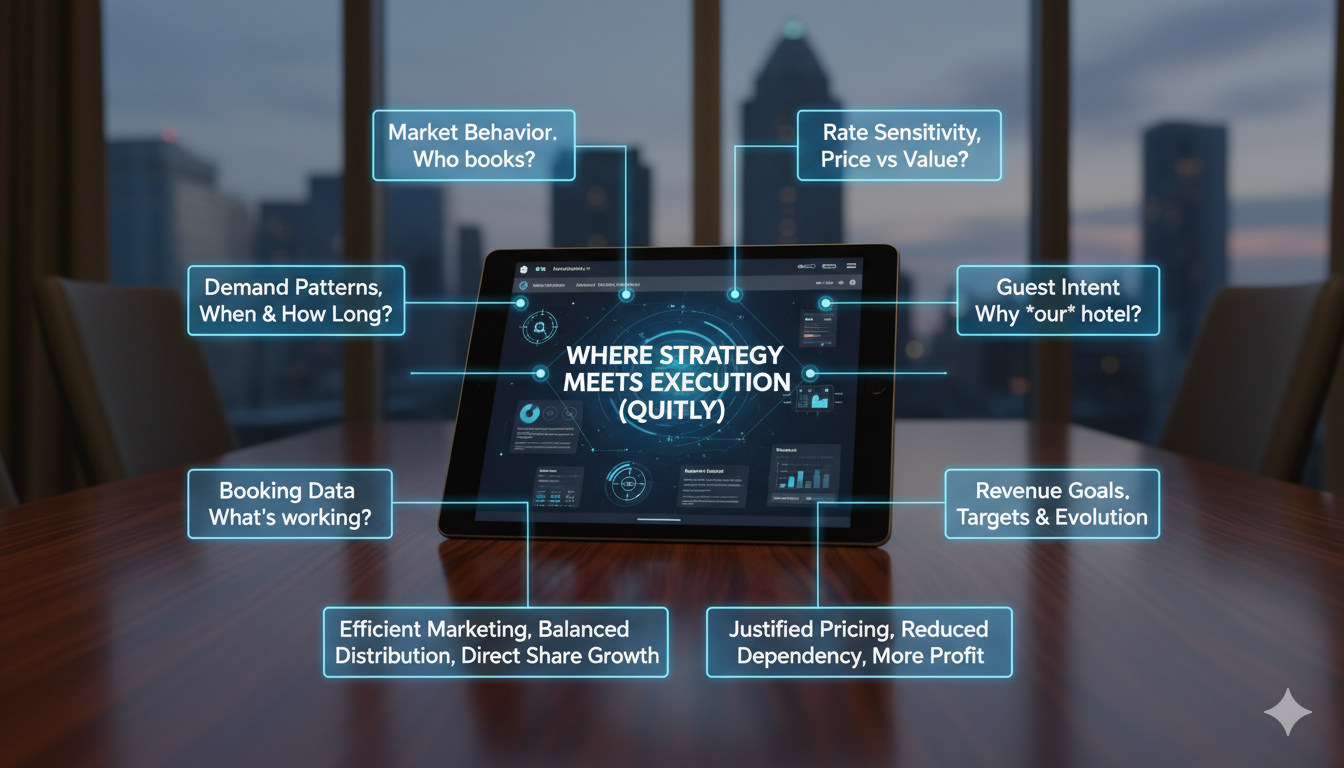
The most effective hotel websites are never built in isolation. They're shaped by deep understanding of market behaviour (Who is actually booking hotels in your segment and area?), demand patterns (When do they book? How far in advance?), booking data (What's working? What's failing?), rate sensitivity, and guest intent analysis.
When website decisions are aligned with revenue thinking, something powerful happens. Not because of one flashy redesign or one big marketing campaign, but because everything starts working together:
- Pricing feels justified. Your rates make sense given the digital experience you've created.
- Marketing becomes efficient. Your campaigns attract qualified traffic that converts.
- Distribution becomes balanced. You're not overly dependent on any single channel.
- Direct share grows naturally. Guests choose to book directly because the experience justifies it.
- Dependency reduces without force. You're not fighting OTAs. You're simply offering a better alternative.
The Hotels That Get This, Grow Differently
You'll notice a pattern among hotels that scale profitably and sustainably. Their websites feel intentional. Every element is there for a reason. Nothing is accidental or inherited from outdated templates. Their pricing feels confident. They're not constantly discounting or competing solely on rate. Their marketing feels focused. They're not chasing every channel. They're targeting the guests they actually want. Their distribution feels controlled. They have healthy direct booking rates alongside OTA presence.
Nothing looks flashy. Nothing feels forced. No auto-playing videos. No aggressive popups. No manipulation. That's because behind the scenes, strategy and execution are speaking the same language. The website design reflects revenue goals. The messaging reflects market understanding. The booking flow reflects conversion psychology. Even if the guest never consciously sees it, they feel it.
The Website Is Not the End Point. It's the Starting Point.
Most hotels treat websites as a one-time project. Build it. Upload content. Forget it. But in reality, a hotel website is a living asset and one that should evolve constantly with demand cycles, market shifts, guest behaviour, and revenue goals. What guests want shifts with seasons and market conditions. Market shifts. New competitors arrive. Pricing changes. Guest profiles evolve. Guest behaviour. How people browse, book, and decide keeps changing. Revenue goals. Your targets change. Your strategy evolves.
When that evolution is guided by data and executed with digital clarity, the website stops being a cost. It becomes leverage. It stops being something you maintain. It becomes something you optimize. The question isn't whether your website is good enough. The question is whether it's working hard enough for your revenue strategy, your pricing power, your marketing efficiency, and your direct bookings. Because every day it isn't, you're leaving money on the table.